
The Power of Muscle in (Peri)Menopause
Barbara Birke, MS, BCHN
Holistic Nutritionist, Sports Scientist, and Menopause Coach
Key Takeaways
Muscle is not just about looking good - it is your most powerful longevity tool, and it becomes especially critical in perimenopause and menopause.
Estrogen decline accelerates muscle loss. Without targeted action, women lose significant muscle mass in the years around menopause.
Strength training at any age - including your 50s, 60s, and beyond - builds and preserves muscle. It is never too late to start.
Muscle protects your metabolism, your bones, your brain, your heart, and your pelvic floor. It is medicine.
You do not need hours in the gym. 20-30 minutes of the right exercises, three times a week, is enough to make a real difference.
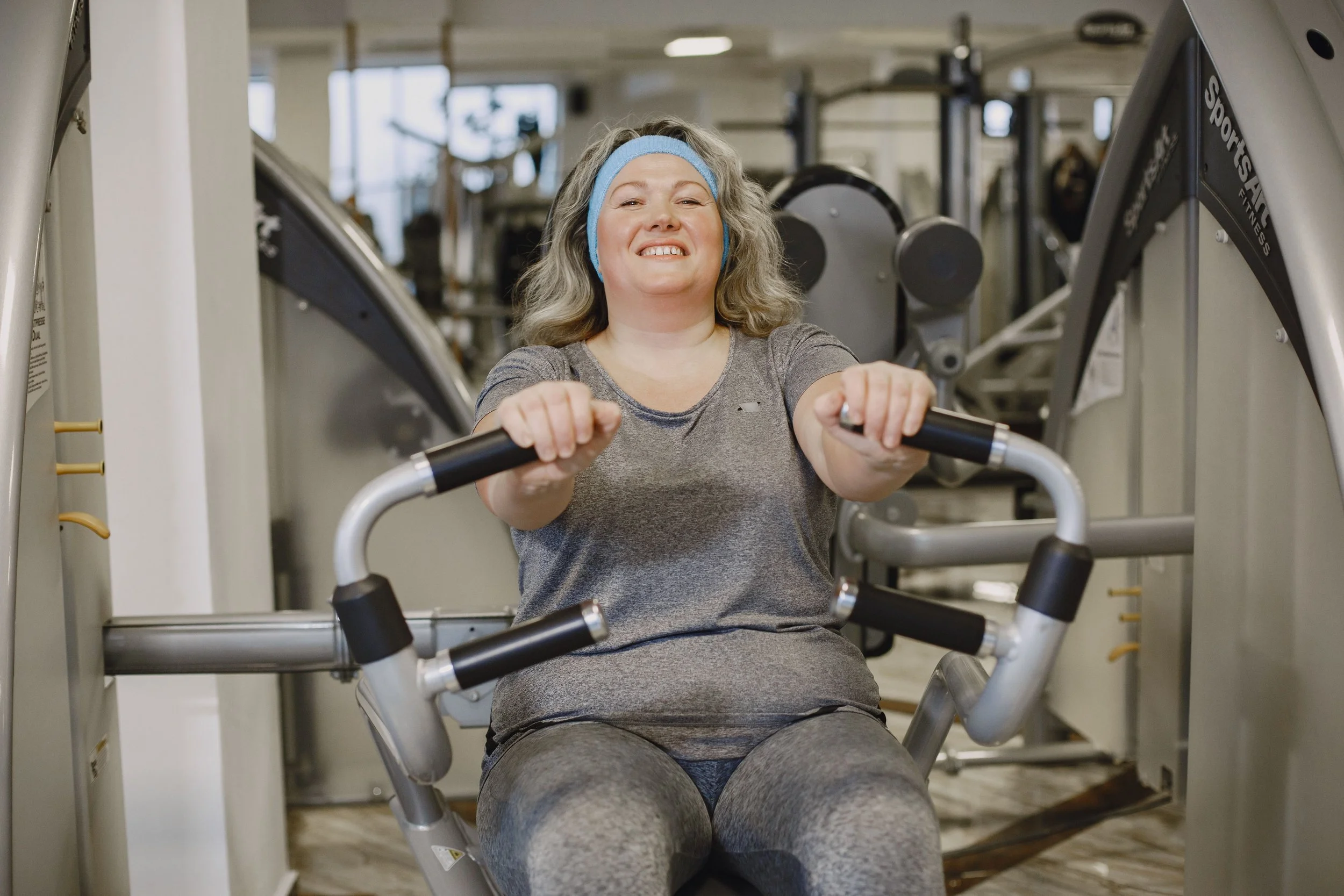
Let me ask you something. When you think about strength training, what comes to mind? Hours in the gym, heavy barbells, sweating alongside 25-year-olds? Or maybe you think it is just not really for you - that it is something other women do, more athletic women, younger women?
I hear this a lot. And I want to gently challenge it, because the science on this is clear and it is compelling: muscle is one of the most important investments you can make in your health right now. Not eventually. Now. Especially if you are in perimenopause or menopause.
This is not just about aesthetics. It is about your energy, your metabolism, your bone density, your brain health, your mood, your independence as you age - and yes, your pelvic floor too. Muscle is not a luxury. Muscle is medicine.
What Actually Happens to Muscle During Perimenopause and Menopause?
Research shows that muscle mass declines due to age and then additionally after menopause due to hormonal changes - and that decline accelerates without intervention. This process has a name: sarcopenia, or age-related muscle loss. It does not happen overnight, and it does not announce itself loudly. It shows up quietly as fatigue, weakness, a slower metabolism, more belly fat, and a body that feels harder to live in.
There is also a process called anabolic resistance to understand here. After 40, the body becomes less efficient at using dietary protein to build and maintain muscle. The same meal that would have supported muscle synthesis at 35 does less of that work at 50. This is why both exercise and nutrition need to shift in this phase - and why doing nothing is not a neutral choice.
Why Is Muscle So Much More Than Strength?
This is where it gets really interesting - and where I want you to shift how you think about muscle entirely. Muscle is not just tissue that moves your body. It is a metabolically active organ that communicates with the rest of your body through chemical messengers called myokines.
When you contract your muscles during exercise, they release myokines into the bloodstream. These myokines have measurable, protective effects on your heart, your brain, your bones, your immune system, and even your mood. They reduce inflammation, improve insulin sensitivity, support cognitive function, and protect against cardiovascular disease. One of the best-studied myokines, irisin, has been shown to cross the blood-brain barrier and support brain health directly. Think of your muscles as a pharmacy that you unlock every time you train.
The implications of this for women in perimenopause and menopause are significant. At the very time that estrogen's protective effects are declining, building and maintaining muscle becomes one of the primary ways to compensate - to keep inflammation low, metabolism healthy, bones strong, and brain sharp. Muscle is working in your favour, if you choose to engage it.
What Muscle Protects in Menopause
Metabolism - muscle burns more energy at rest than fat tissue; more muscle means a higher resting metabolic rate.
Blood sugar regulation - muscle tissue is a major site of glucose uptake; more muscle means better insulin sensitivity and less belly fat.
Bone density - resistance training creates mechanical stress on bones, which stimulates bone remodelling and reduces osteoporosis risk.
Brain health - myokines released during exercise support cognitive function and reduce dementia risk.
Heart health - strength training improves cardiovascular markers including blood pressure, cholesterol, and resting heart rate.
Mood and energy - exercise increases serotonin and dopamine; women consistently report better mood and energy with regular strength training.
Pelvic floor function - integrated strength training supports the deep core system, including the pelvic floor muscles, reducing the risk of prolapse and incontinence.
Does Strength Training Actually Work in Menopause - or Is It Too Late?
This is one of the questions I get most often, and the answer is unequivocal: yes, it works. At any age. At any starting point.
A landmark 2025 study from the University of Exeter - the first of its kind to compare the effects of resistance training across pre-, peri-, and post-menopause - found that menopause does not affect a woman's ability to build muscle through exercise. Participants across all menopausal stages got stronger. Those who trained consistently saw significant improvements in lower body strength, full-body flexibility, and balance and stability. The takeaway is important: the window has not closed. It is wide open.
A 2025 randomised controlled trial published in BMJ Open found that high-intensity resistance and impact training in perimenopausal and early postmenopausal women improved lean body mass, muscle strength, and quality of life. Another 2025 review in the journal Menopause confirmed that resistance training - particularly with heavier weights and lower repetitions - is the single most evidence-supported non-pharmacological strategy for preserving muscle and bone health through this transition.
What the research also makes clear is that postmenopausal women may need slightly higher training volumes than younger women to achieve the same muscle-building effect. Standard generic fitness advice is often not enough. This is exactly why I designed Power&Balance specifically for women in this phase - the exercises, the progression, and the approach are all tailored to what actually works for our bodies now.
What About the Pelvic Floor - Is There a Connection?
There is, and it is worth understanding. The pelvic floor is part of the deep core system - a group of muscles that work together with the diaphragm, the deep abdominal muscles, and the muscles of the lower back to stabilise the pelvis and spine. These muscles do not work in isolation. How you breathe, how you brace, how you move during exercise all affect pelvic floor function.
Well-programmed strength training that integrates pelvic floor awareness - coordinating breath and intra-abdominal pressure with movement - actively supports pelvic floor health rather than putting it at risk. This is especially relevant in perimenopause and menopause, when declining estrogen affects the connective tissue of the pelvic floor and the risk of prolapse and stress incontinence increases. Strong glutes, strong hips, a strong deep core, and a well-coordinated pelvic floor are all connected. Building one supports the others.
Where Do You Start if You Have Never Really Done This Before?
You start simply. You start where you are. And you do not need to figure it all out at once.
The most important thing to understand is that more is not automatically better. Consistency, correct technique, and progressive overload - gradually increasing the challenge over time - are what drive results. Two to three sessions per week, 30-45 minutes each, with a focus on compound movements that work multiple muscle groups at once, is genuinely enough to build strength, preserve muscle, and feel the difference.
If you are not sure where to begin, I have put together a free download with three practical tips to get started with strength training - written specifically for us women in this phase of life. It covers what to focus on, what to avoid, and how to build a foundation you can actually sustain.
Conclusion
Perimenopause and menopause are not the beginning of a decline. They are a genuinely important turning point - a window of opportunity to build the physical foundation that will support you for decades. The women I work with who start strength training in this phase consistently tell me it changes how they feel in their bodies, how much energy they have, how they sleep, and how confident they feel. Not because they look different. Because they feel strong.
Your body is capable of more than you might think right now. Book in for a free discovery call today and let's find out together.
References
Wright VJ, Schwartzman JD, Itinoche R, Wittstein J. The musculoskeletal syndrome of menopause. Climacteric. 2024;27(5):466-472. https://pubmed.ncbi.nlm.nih.gov/39077777/
Menzies C, Bowtell R, Shur N, Brook MS. Menopause, Female Sex Hormones, Skeletal Muscle Mass and Muscle Protein Turnover in Humans. J Cachexia Sarcopenia Muscle. 2026 Feb 18;17(1):e70232. https://pubmed.ncbi.nlm.nih.gov/41707658/
Collins BC, Laakkonen EK, Lowe DA. Menopause, Female Sex Hormones, Skeletal Muscle Mass and Function. Endocr Rev. 2019;40(5):1103-1124. https://pubmed.ncbi.nlm.nih.gov/30930293/
University of Exeter. First-of-its-kind study shows resistance training can improve physical function during menopause. 2025. https://news.exeter.ac.uk/faculty-of-health-and-life-sciences/first-of-its-kind-study-shows-resistan ce-training-can-improve-physical-function-during-menopause/
BMJ Open. High-intensity resistance and impact training in perimenopausal and early postmenopausal women. 2025;15(2):e093711. https://bmjopen.bmj.com/content/15/2/e093711
Tandfonline. The musculoskeletal effects of resistance training across menopausal stages. Menopause. 2025. https://www.tandfonline.com/doi/full/10.1080/13697137.2024.2380363
Frontiers in Endocrinology. Lower muscle mass linked to more severe menopausal symptoms. 2025. https://www.frontiersin.org/journals/endocrinology/articles/10.3389/fendo.2025.1628612/full
Fanny Buckinx et al. Sarcopenia in Menopausal Women: Current Perspectives. Int J Womens Health. 2022. https://pmc.ncbi.nlm.nih.gov/articles/PMC9235827/